Oct 10, 2026Technology Explained
Do Solar Security Cameras Work in Winter? The Battery & Charging Truth
Short days, low sun and cold batteries — how much do they really hurt solar cameras? What matters, what doesn't, and how to keep recording all winter.
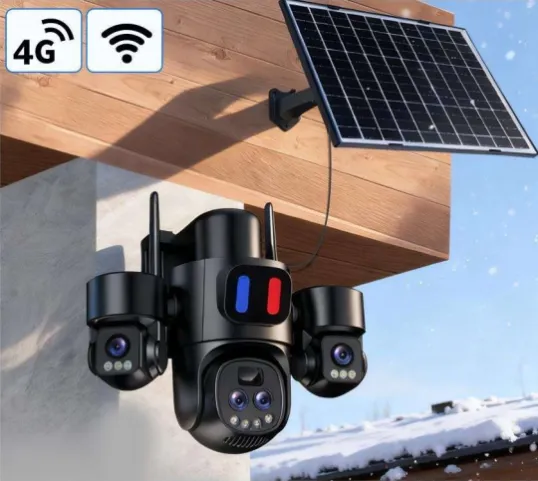
This is the question we get most as winter approaches, and the honest answer is: yes, solar cameras work in winter — but winter is a "use it wisely" season, not a "set and forget" one. Three things change: days get shorter and the sun sits lower (less charging), and cold reduces how much capacity a lithium battery delivers. None of these are fatal if the model is matched to your winter. This guide, written by the manufacturer (we build and export solar cameras to distributors and brands in 40+ countries), separates what actually matters from the marketing myths, and gives you a winter-proofing checklist.After reading, you'll know: why winter hurts solar cameras (and how much), which specs to check before buying for a cold region, and how to keep a solar camera recording through the worst months.Short answer: choose a model with a large battery (8000–20000 mAh) and a higher-wattage panel (10–15 W) for cold regions, set the panel steeper for the low winter sun, use motion-triggered or AOV recording instead of full 24/7, and keep the panel clear of snow.
Why winter is hard for solar cameras — three factors, one equation
- Less sun. Winter days are shorter and the sun is lower — a panel that worked in July may charge half as much in December.
- Cold batteries. Lithium batteries deliver less usable capacity in cold: roughly 10–30% less around 0°C, 20–40% less around −10°C, and more than 40% below −20°C (industry figures vary by chemistry and rate).
- Higher drain. Cold increases internal resistance, so the same camera draws more from a battery that has less to give.
These three stack. That's why "it worked all summer" tells you nothing about December — the winter question is about the combination of battery size, panel power, and how the camera records.
How much sun does your winter actually have?
Winter charging depends on your latitude:
Location | Winter daylight (approx.) | Winter sun height | Solar camera advice |
Tropics (0–15°) | 11–12 h, year-round | High | Little changes; standard solar models fine |
Mid-latitude (35–50°, e.g. US/Europe core) | 8–10 h | Low | Steep panel angle, larger battery, power-saving mode |
High latitude (50–60°+) | 5–8 h | Very low | Max panel, max battery, motion-only recording; consider hybrid |
Panel angle matters more than people think: research shows an improper angle can cut panel output by 10–40%, and a simple seasonal rule is latitude + 15° in winter, − 15° in summer. A steep winter tilt faces the low sun directly and can recover a meaningful share of lost output. In the Northern Hemisphere, adjust the angle in October–November before the sun drops for the season — doing it in January is like closing the gate after the horse has gone.
Cold and the battery: what the number really means
A 20000 mAh battery at −10°C does not behave like 20000 mAh in July — think of it as roughly 60–80% of rated capacity, temporarily. That's normal lithium behavior, not a defect. What it means practically:
- Buy more battery than summer needs. A 20000 mAh unit (our 10-cell solar models) has real winter headroom; an 8000–10800 mAh unit is a summer-and-mild-winter choice.
- Model operating range matters. Check the rated temperature: the EXF-DQS8-B4L street-lamp series is rated −20°C to +55°C, and the VTS outdoor series (VTS02/VTS28) is rated −30°C to +50°C. If your winter regularly goes below −20°C, tell us — that's a spec conversation, not a sales one.
- Cold also slows charging. The panel can generate, but very cold batteries accept charge more slowly — another reason to start winter with a full battery.
What actually keeps a solar camera alive in winter
Ranked by impact:
- Recording mode — the single biggest lever. Full 24/7 recording all winter drains any battery; motion-triggered recording stretches it many times over. AOV (continuous but smart-powered) recording is the middle ground for those who want 24/7 footage without burning the battery.
- Battery size — 20000 mAh gives weeks of standby on motion-only; match it to your winter.
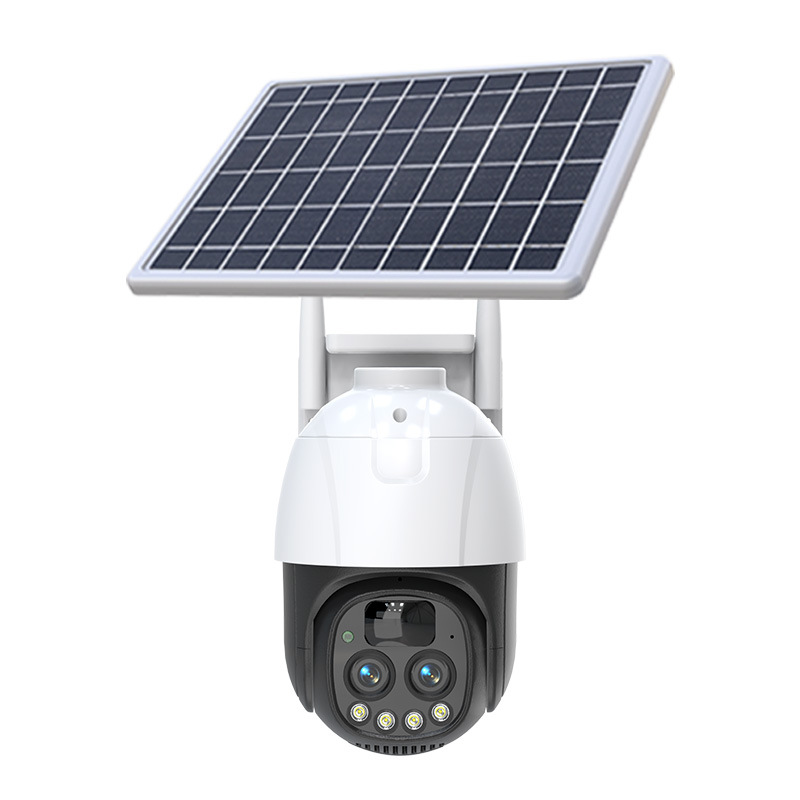
- Panel wattage & angle — 10–15 W panels with a steep winter tilt (latitude + 15°).
- Panel placement — direct sun, no shade, and clear of snow. Twice-a-year cleaning applies more in winter: snow, ice and road salt reduce charging.
- Start full — fully charge the camera in late autumn so it enters winter with maximum reserve.
Two myths worth clearing up. Myth 1: "cold permanently ruins the battery." No — cold capacity loss is temporary; the battery recovers when it warms. What genuinely damages batteries is sitting empty for weeks. Myth 2: "a bigger panel fixes everything." A big panel on the wrong angle in shade still undercharges — panel wattage, battery size and recording mode work as a set, not individually.
Model guidance by winter severity
Winter type | What to look for | KeenCamPro examples |
Mild winter (rarely below 0°C) | Standard battery + panel; motion mode in cold spells | EXF-QS8-B4M24 (zoom), EXF-QS12-B6T (three-lens) |
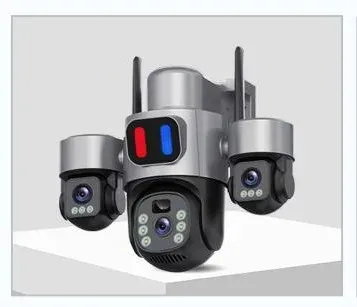
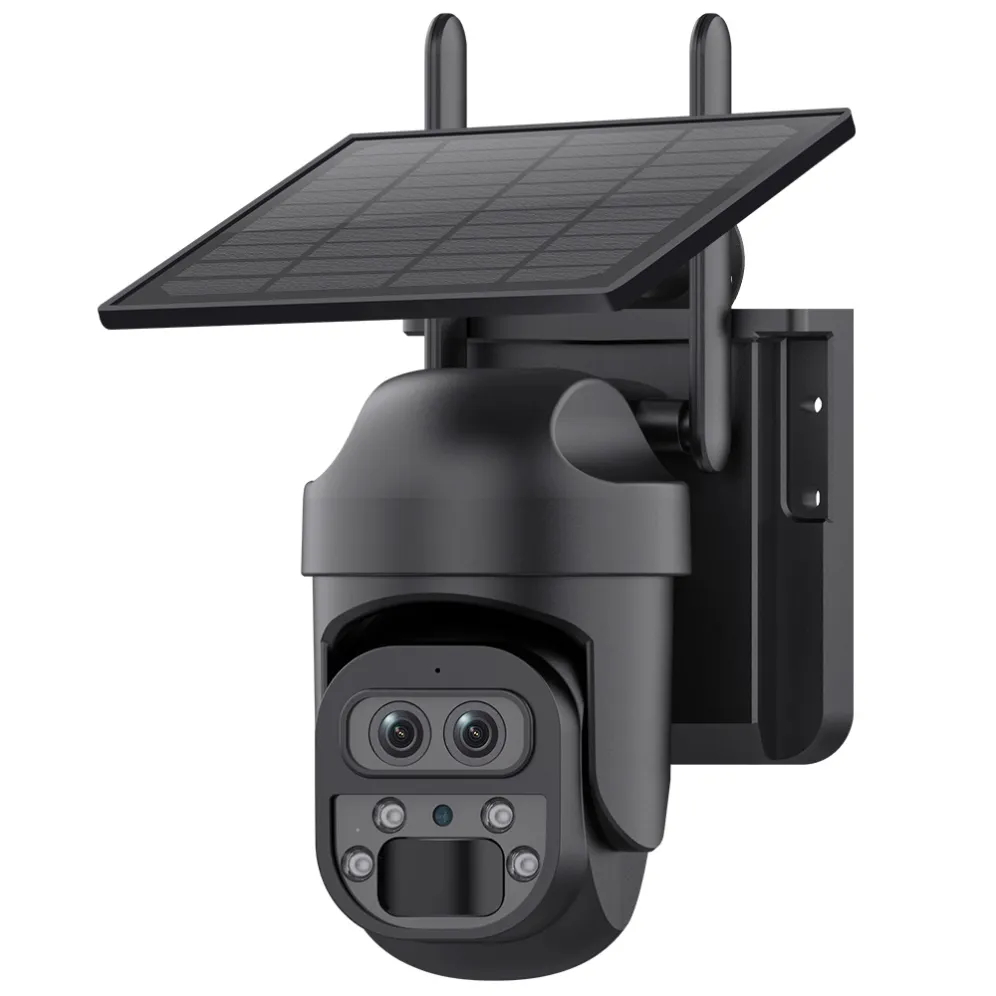
Cold winter (to −10°C) | 10800 mAh battery, motion/AOV recording | EXF-QS16-B4L (dual-lens, 4G+WiFi, 10800 mAh, 7.5 W panel), EXF-DQS8-B4L(A/C) street lamp (20000 mAh) |
Severe winter (to −20°C or below) | 20000 mAh, 15 W panel, motion-only recording, rated −20°C+ | EXF-DQS8-B4L(A) (15 W panel), VTS outdoor series (−30°C rated) |
If your site has no sun for weeks (northern winters), be honest with yourself: consider a 4G + larger-battery model with motion recording, or a hybrid power option — we'll confirm what fits rather than promise magic.
Winter installation checklist
- Tilt the panel to latitude + 15° before the season starts.
- Confirm no new shade (leaves gone = good; roof snow slides = bad).
- Fully charge the camera; set motion-triggered or AOV recording.
- Clear snow off the panel after storms; check the lens for frost.
- Update firmware — cold-season fixes often arrive as updates.
- Test at night: PIR range and night vision behave differently in cold.
FAQ
Do solar security cameras work in winter? Yes, if matched to the winter. Large battery, higher-wattage panel, steep tilt and motion/AOV recording keep most models recording through cold months; extreme-winter sites need the spec conversation.Why does my solar camera die in winter? Short days (less charging) plus cold (battery delivers less capacity). Fix: steepen the panel, switch to motion-triggered recording, start the season fully charged.How much battery does a solar camera lose in the cold? Industry figures: roughly 10–30% less usable capacity around 0°C, 20–40% around −10°C, more than 40% below −20°C. It's temporary, not permanent damage.Should I tilt my solar panel in winter? Yes — roughly latitude + 15°. An improper angle can cut output by 10–40%; the seasonal tilt directly faces the low winter sun.Can solar cameras record 24/7 in winter? Full 24/7 drains any battery in short-sun months. AOV or motion-triggered recording is the realistic 24/7 compromise; confirm the mode on your model.What temperature can solar cameras handle? Our solar models are rated −20°C to +55°C; the VTS outdoor series is rated −30°C to +50°C. If your winter goes below the rating, ask us about suitable models rather than risking it.Do I need to clean the panel in winter? Yes — snow, ice and road salt cut charging. Clear the panel after storms and keep the lens free of frost.What if snow covers the panel for days? Charge what you can: clear the panel after each storm, keep the recording mode lean (motion/AOV), and start the season fully charged. Sites with weeks of no sun should use a larger battery, a 4G model, or a hybrid power option — tell us your location and we'll advise honestly.
What to prepare before your inquiry
For a winter-matched recommendation, send us:
- Location & latitude — country/city; how cold does winter get?
- Sun situation — direct sun hours in winter; any shade?
- Recording needs — full 24/7, AOV, or motion clips?
- Usage — home, farm, construction, remote site?
- Power preference — solar only, or solar + 4G for reliability?
- Quantity, target market, packaging — volume, destination, your brand or our standard box.
Buying as a reseller? Go straight to the factory
Distributors, importers and brand owners buy direct from the manufacturer:
- 100+ models in one catalog — solar, 4G, WiFi, plug-in, battery, AOV, optical zoom, alarm, pet cameras.
- OEM/ODM welcome — your brand, our factory, small MOQ, fast delivery.
- Free technical support for app, firmware and packaging customization.
Browse the solar camera category on our website: www.keencampro.comRequest a quote — contact our sales team to confirm model, coverage and MOQ today:
- WhatsApp: https://wa.me/8618948579719
- Email: diana@keencampro.com
- Website: https://www.keencampro.com/
#KeenCamPro #SolarCameraWinter #SolarSecurityCamera #DoSolarCamerasWorkInWinter #SolarPanelAngle #SolarCameraBattery #ColdWeatherCamera #4GSecurityCamera #OutdoorCamera #WirelessCamera #OEM #Wholesale