Oct 22, 2026Buying Guides
Security Cameras for Farms with No WiFi and No Power: An Off-Grid Buyer's Guide
Off-grid farm cameras need no mains power or WiFi, but four constraints decide whether a specification works: winter sun at the mount, cold battery capacity, signal at the spot, and footage retrieval.
Yes, you can run a security camera where there is no outlet and no internet. Electrical wiring and a router are not required for recording, and that is exactly how a barn, a remote pasture, a water tank or an equipment yard gets covered. What the camera does require is a different budget than a plug-in model: sun at the mount, a battery sized for the coldest month, a cellular link where you want remote alerts, and a plan for retrieving footage from a memory card.
This guide is written for the buying decision rather than the installation. It covers how an off-grid camera's job divides into three parts, which power and connectivity options actually exist, the four constraints that decide whether a specification is real or aspirational, and what to send a factory before requesting a quotation.
Off-grid does not mean maintenance-free
The honest framing first: a solar camera depends on sunlight, a battery and a working link. Winter reduces both the energy the panel collects and the energy the battery can deliver. No camera escapes that, and any supplier promising a unit that runs forever without attention is describing a product that does not exist. What a well-specified system does deliver is coverage through a real winter, provided the specification was chosen for winter rather than for August.
The camera's job has three parts, and they have different requirements
Most buyers treat a security camera as one thing that needs electricity and WiFi. On an off-grid site it helps to separate the job into three parts, because each part has a different dependency.
Recording happens on a memory card inside the camera. It needs power from the panel and battery, and it needs no network at all. This is the part that matters most for evidence, and it is the part an off-grid site can always have.
Live viewing and push alerts need a link. WiFi is free but range-limited; a 4G cellular version reaches remote spots but needs a SIM and a data plan. Without any link you lose remote live view and remote alerts, but you do not lose recording.
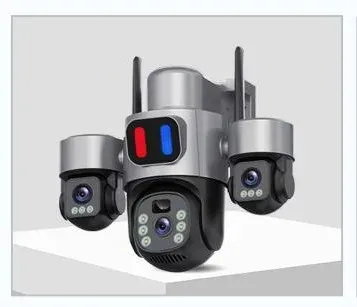
Deterrence comes from the camera's own hardware. Motion-triggered white light, a sound alarm or a red and blue warning light all run on the camera's battery and require no network and no subscription.
Split this way, the buying question stops being whether one unit does everything and becomes which combination fits each spot. The barn may justify 4G for remote alerts. The far water tank may only justify local recording, because the signal is not there.
Placement comes before wiring
The points that get hit on a farm are the ones far from the house, rarely visited, and full of portable value: tools, feed, fuel, livestock, pumps. A camera on the house wall records none of that. The wiring conversation only matters because the placement conversation identified those spots. Decide which points must be covered first, then work out how to power and connect each one, rather than choosing a camera and looking for somewhere to put it.
Power options when there is no outlet
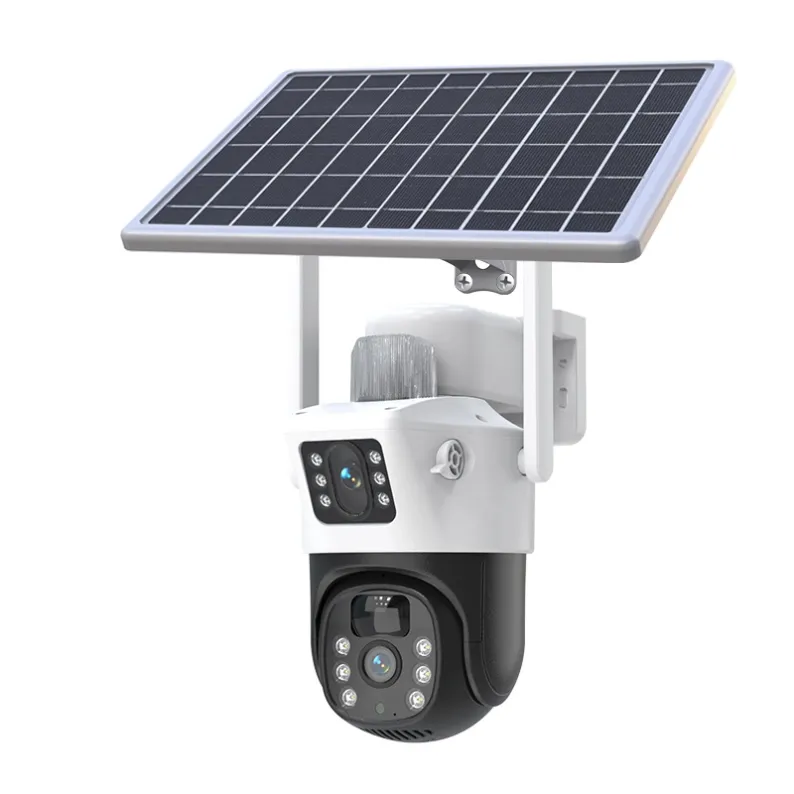
Solar plus battery is the standard for farm sites and the option most installations end up using. A panel charges the battery during the day and the camera runs from the battery at night and in poor weather. The specification that matters is not the brand but the combination: panel wattage, battery capacity, and the recording mode the camera will run in.
On our own solar range the figures are published per model rather than as a single range, because they differ substantially. Batteries run from 5600mAh on a compact indoor unit to 20000mAh on the solar street lamp cameras, and solar panels run from 7.5W on the compact solar PTZ bodies through 12W on the street lamp models to 20W and 30W on the higher-output long-zoom models. A camera with 20x or 36x optical zoom draws more than a compact PTZ that only wakes on a trigger, which is why the panel rating rises with the feature set.
Battery only, with no panel, is realistic for short deployments, seasonal use or a spot you can reach easily. It means charging or swapping units on a schedule, so it suits a rotation plan rather than permanent coverage.
Mains power, where a shed already has it, usually wins on cost and reliability. Wired and plug-in cameras make sense for the near-house spots, which frees the solar budget for the remote ones.
Constraint one: does the panel see winter sun at that spot?
This is the constraint that decides most failed installations. A panel position that clears a fence or roofline in June can be shaded for hours in December, because the sun sits lower in the sky. Check the panel spot at the winter solstice, not on the day you buy.
Snow is the second half of the same problem. A steeply tilted panel sheds snow more readily than a flat one. On cleaning, the U.S. Department of Energy's Federal Energy Management Program advises against manual removal of snow and ice from photovoltaic modules, warning that shovels can cause damage and that removing snow can do more harm than good, and recommends soft tools such as brooms and brushes if removal is attempted at all. Treat a hard scraper as a way to destroy the panel you depend on.
Constraint two: what the battery can actually deliver in the cold
Cold does not change a lithium battery's rated capacity printed on the datasheet. It changes how much of that capacity can be drawn at the temperature in question, and most of the loss returns once the cell warms up. The magnitude is larger than most buyers expect. A production LiFePO4 cell specification quotes around 85 percent of its 25 degrees Celsius capacity at 0 degrees Celsius and around 75 percent at minus 20 degrees Celsius at a 1C discharge rate, and published low-temperature reviews report reversible capacity falling to roughly a quarter of room-temperature values below minus 20 degrees Celsius, with some commercial cells unable to discharge at all at minus 30 degrees Celsius.
The practical reading is not a single percentage but a design rule: size the battery for the coldest month you will actually operate in, not for the average. Charging below freezing is a separate constraint from discharging, which is why the working temperature range on the datasheet matters as much as the milliamp-hour figure.
Constraint three: signal at the exact mount point
Test the connection standing where the camera will be mounted, not in the farmyard or at the gate. A camera ten meters from a working router can sit in a dead zone behind a steel-clad wall, and a cellular signal that shows two bars at the track can be absent at the tank.
Rural connectivity gaps are a real planning input rather than a rare exception. The FCC's 2024 Section 706 Broadband Deployment Report found that fixed terrestrial broadband at 100/20 Mbps had not been physically deployed to almost 28 percent of Americans in rural areas, satellite excluded, based on data as of December 31, 2022. Two things follow for a buyer: cellular coverage cannot be assumed at any given spot, and the figure has since improved, because the FCC's 2026 report shows the rural gap falling by more than 44 percent over two years. The only reliable test remains a handset at the mount.
Where the signal exists, order the regional 4G version that matches the destination market. Bands differ between regions and a version built for one market may not register on another market's network. Where the signal does not exist, local-card recording is the honest answer: the footage is there, and you retrieve it by visiting the site.
Constraint four: how you will actually retrieve the footage
Decide this before you install, because it sets the card size, the visit frequency and whether the spot needs a link at all. Remote app review needs a working link. Card retrieval needs physical access and a routine. A site with neither a link nor regular visits will accumulate footage nobody watches, which is a specification failure even though the camera is working.
Card size should follow event volume rather than the maximum the camera accepts. A camera recording on motion at a busy gate fills a card far faster than one watching an empty shed, and the right answer is the largest card the model supports plus a retrieval habit that matches the traffic.
Matching the configuration to the spot
The pattern below is what we see most often on farm enquiries. It is a starting point for a quotation, not a substitute for the signal and sun checks above.
Barn or stable, no power: solar camera, WiFi if it genuinely reaches, otherwise the 4G version, with local card recording as the fallback. Motion recording stretches the battery, and a light or sound deterrent is worth having if the building is visited rarely.
Remote pasture or grazing land, no power and no WiFi: solar 4G camera with local card recording. Carrier signal test first, winter battery discipline second.
Water tank or pump station: solar camera, with WiFi or 4G depending on what the site actually has. Tamper alerts are useful, but the physical protection on the pump itself is what stops the loss.
Equipment or fuel yard: a solar model with light and sound deterrence, plus local recording. Deterrence carries more value here than image resolution, and the footage must survive an incident.
Seasonal cabin or outbuilding: solar camera with local-card recording, reviewed during site visits. This is the configuration that avoids a monthly data bill on a building that is empty half the year.
Recording mode is the lever most buyers miss
Two cameras with identical panels and batteries can have very different winter endurance depending on how they record. Motion-triggered event recording draws power only when something moves, which is what makes a solar camera viable at all on a marginal site. Continuous recording draws far more and needs a larger panel and battery to survive the same winter.
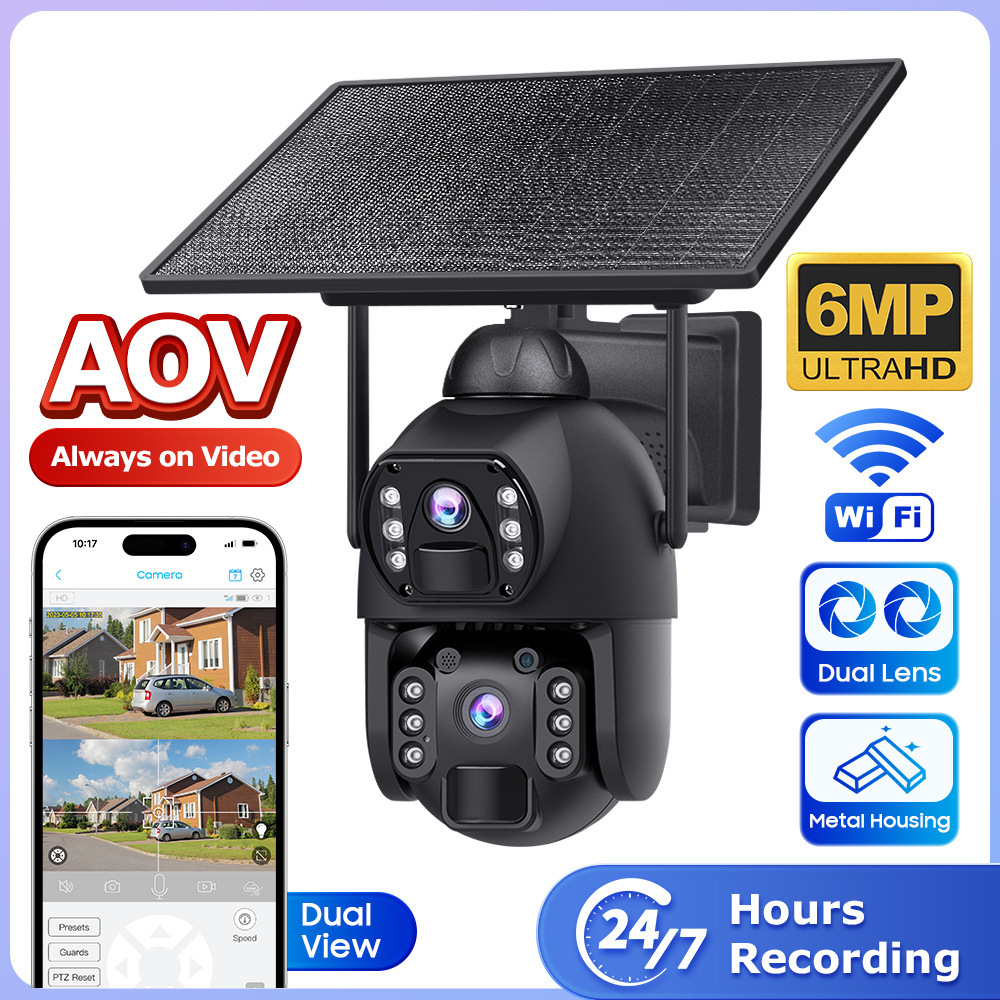
AOV is the middle path worth asking about if you need continuous coverage rather than events. AOV, always-on video, records continuously at low power rather than waking on a trigger, so it gives uninterrupted coverage without the battery cost of full-rate continuous HD. Recording behaviour is stated per model in our range rather than assumed across it.
One caution: do not assume a hotspot or direct-connect viewing mode is present unless the model states it. In our own range the WiFi hotspot function appears on the car guard dash cameras, not on the solar models, so a buyer who needs on-site phone viewing without a network should confirm that capability against the specific datasheet rather than a general product category.
Mistakes that turn into a February failure
Sizing the system for summer. A configuration that works in August can fail in February if it records continuously and the panel is shaded in winter.
Ordering the cellular camera before testing signal. The camera is rarely the problem; coverage is. Test the mount, then decide between 4G and local-only for that spot.
Treating the panel as self-cleaning. Snow and dust both reduce input, and the DOE guidance above is clear that heavy-handed removal is worse than leaving it.
Buying the wrong regional 4G version. Confirm the bands for the destination country before ordering. A mismatched unit will not register, and on a remote site that is not a repairable mistake.
Expecting the camera to be the whole security system. It records, it deters, it alerts. It does not stop a determined thief. Locks, chains, gates and signage do that, and the physical layer matters more at a remote site, not less.
Undersizing the memory card. Event recording on an active farm fills a card in weeks rather than years, and a full card is a camera that stopped recording.
Frequently asked questions
Can a security camera work with no electricity at all? A solar model runs from its panel and battery with no mains connection, and records to a local card. What it needs is sunlight at the mount and a battery sized for the coldest month.
Can it work with no WiFi? Yes, in two ways. A 4G cellular version gives remote live view and alerts over a mobile network with a SIM and data plan. Without any link, the camera still records locally, and you retrieve the footage on site.
For a barn with no WiFi, is 4G or local card better? If the carrier has usable signal at the barn, 4G buys remote alerts and live view. If the signal is not there, local recording is the honest configuration. Test the signal at the mount before ordering either.
How long will a solar camera run without sun? It depends on battery capacity, panel wattage and recording mode, and the answer is specific to the model and its settings. Ask the supplier for expected runtime in the recording mode you intend to use, and check the charge trend in the app over the first weeks of operation.
Do off-grid cameras work in winter? They can, with the right configuration: event or low-power recording, a panel that is not shaded in winter, snow that sheds rather than accumulates, and a datasheet whose working temperature covers your climate.
What size memory card do I need? Size it against event volume and retrieval frequency, not against the largest card the camera accepts. On a busy farm, motion recording can fill a moderate card within weeks.
Can two cameras share one solar panel? Some multi-lens configurations ship with two panels, such as the 7.5W times two arrangement on certain four-lens models. Whether a split is possible on a specific model depends on its charging input and the supplied panel, so confirm against the model rather than across the range.
What to send before you ask for a quotation
A supplier can only size an off-grid system against real site data. Photographs of the mount points and a signal reading are worth more than a paragraph of description.
The spots and distances: which points have no power, which have no WiFi, and how far they are from the house or the nearest access point.
Signal results at each mount, taken with a handset standing where the camera will go, plus the destination country so the correct 4G band version can be quoted.
The climate: the coldest winter temperature you expect to operate in, typical snowfall, and how much sun the mount receives in December.
The recording requirement: motion events only, or continuous coverage. This single answer changes the panel and battery specification more than any other.
The commercial context: whether you are an end user, a dealer quoting a project, or a brand planning a line, together with quantity and destination market.
Ordering from the factory
KeenCamPro manufactures in Huizhou, Guangdong and supplies the solar and 4G camera range direct to farms, dealers and brand owners. The catalog covers solar models from compact single-lens PTZ bodies to four and five-lens AOV cameras with 20x and 36x optical zoom, plus trail, pet and plug-in ranges. Regional 4G versions are available for the main markets, and OEM and ODM projects are supported with custom branding and packaging.
For an off-grid quotation, send the site details above through the contact form or by email, and the sales team will confirm model categories, the regional 4G version and the power configuration that matches each spot.
Browse the solar camera and AOV camera categories on the website, or contact the export team at sales@keencampro.com or diana@keencampro.com, or on WhatsApp at plus 86 189 4857 9719.