Oct 22, 2026Buying Guides
Remote Water Monitoring on a Farm: Cameras for Boreholes, Tanks, Troughs and Pump Stations
A camera at a borehole, tank or pump station records who approached and what happened, but it cannot measure level or flow. How to place, power and specify one.
A borehole, a stock tank, a trough or a pump station is one of the few places on a farm that carries both a high replacement cost and a daily dependency: if the pump is damaged or the tank runs dry, animals and irrigation stop within hours. It is also, almost always, the point furthest from the house. That combination is why water infrastructure is one of the most common places our farm customers put a camera, and why it needs a different setup from a barn camera.
This guide covers what a camera can and cannot tell you at a water point, how to choose the mounting position, which camera behaviour matters at night around a pump house, and what to send a supplier so the power and signal are right for that specific spot.
What a camera at a water point is actually for
It is worth separating three jobs, because water sites invite confusion between them. A camera is a visual and event sensor, not an instrument. It shows you who approached, what they did, and what the site looked like at a given moment. It records an incident you can act on, and it can make an intruder visible enough to leave.
What it does not do is measure. It does not tell you the water level in a tank, the flow rate through a pipe, the pressure at a pump, or whether a borehole has run dry. Those need level sensors, flow meters or pressure switches. A camera can show you a gauge or a sight glass if one exists and the resolution and distance allow it, but that is a visual aid rather than a measurement, and specifying a camera as a substitute for a sensor is how projects end up with a system that reports nothing when it matters.
The practical consequence is that a camera complements the automation you already have. If the pump controller already alarms on low level or dry run, the camera's job is to show you the cause, not to be the alarm.
Why water points get targeted, and what that changes about placement
Three things make a pump site attractive. It holds equipment with resale value, it is usually screened from the road and from the house, and it is visited on a schedule rather than continuously, so an intruder has time. Livestock add a different kind of risk: a trough that is knocked over or a float valve that jams causes loss without any intruder at all.
That mix changes what you want to see. A camera pointed at the tank top only records the tank. What you actually need is the approach: the track, gate or fence line by which anything arrives. Put the tank in the frame, but frame the way in first. If the pump house door is the target, the camera should see the door and the approach together, so the record shows the person arriving rather than a door opening on its own.
Sizing power for a water point, not for the house
Water sites tend to share two properties that work against a camera: they are the furthest point from power, and they often sit in the most exposed position on the farm, which is good for wind and bad for shading because a pump house, a tank stand or a shelter can put the panel in shadow for part of the day.
Check the panel position at the worst month rather than at installation. A panel that clears a tank stand in June can be shaded by the same stand in December, when the sun sits lower and the useful window is shorter. If the only structurally sound mounting point is shaded, either raise the panel on its own bracket or accept a smaller camera with a lower continuous draw rather than fitting a bigger unit that cannot charge.
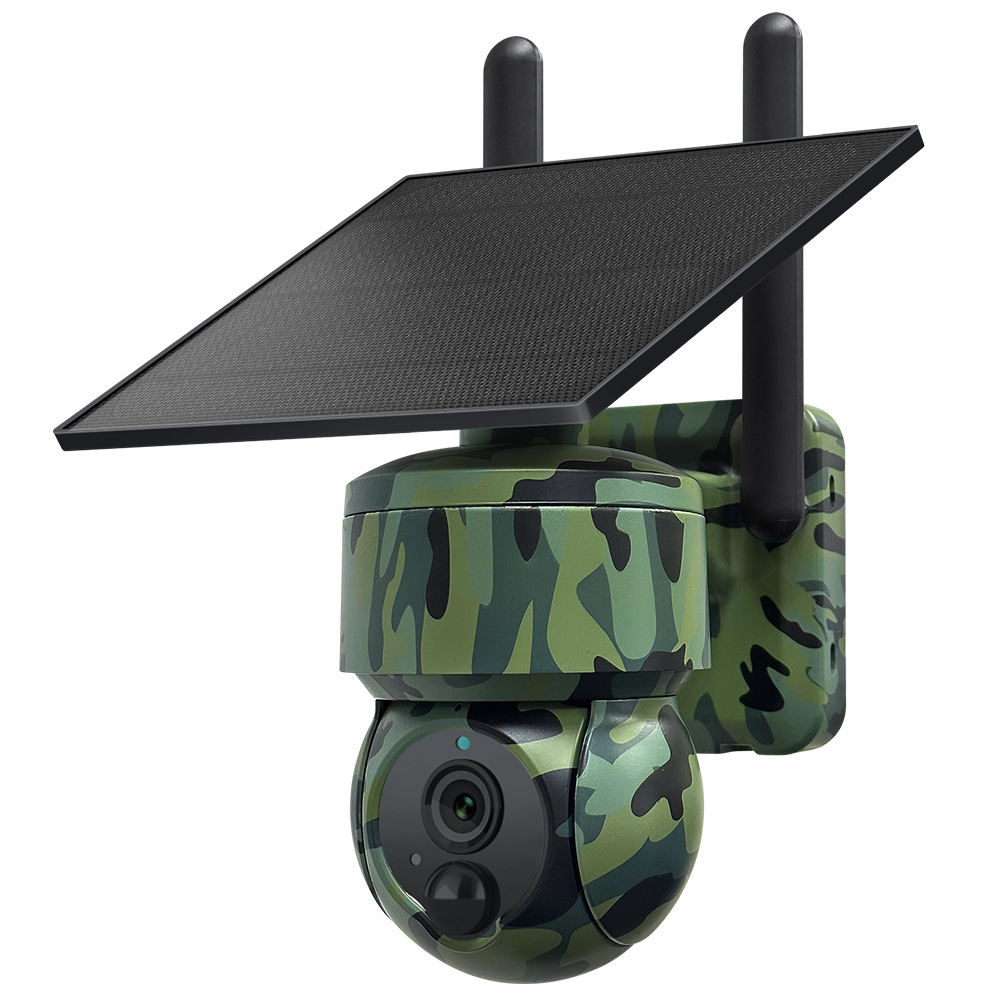
Battery and panel figures in our own solar range run from 5600mAh with a compact indoor unit up to 20000mAh on the solar street lamp cameras, with panels from 7.5W on the compact solar PTZ bodies through 12W on the street lamp models to 20W and 30W on the higher-output long-zoom models. At a water point the useful question is not which is biggest but which combination survives your worst month in the recording mode you intend to run.
Recording mode decides the winter, not the battery label
Two cameras with the same battery and panel can behave very differently at a water point depending on how they record. A trough or a pump house is a low-traffic scene: most of the day nothing moves except animals at the trough. That is exactly the profile where motion-triggered recording earns its keep, because the camera is idle for long stretches and only draws power when there is a reason.
If you need continuous coverage rather than events, AOV models are the middle path: they record continuously at low power instead of waking on a trigger, so you get uninterrupted footage without the battery cost of full-rate continuous HD. In our range AOV models are identified as such, and the recording behaviour is stated per model rather than assumed across the range. For a pump house where the event of interest might be slow, such as a leak developing behind the housing, continuous or AOV coverage is worth the extra panel and battery you will need.
What to expect from night vision around a pump house
Water sites are usually darkest exactly where you need detail. Two effects matter more here than on a house wall. First, infrared will pick up anything close to the lens and blow out the exposure, so a mounting position that puts a fence post, a pipe or a tank edge within a metre of the camera will produce a bright obstruction and a dark scene. Second, a white light or full-colour mode is a deterrent as well as an illuminator, but it also announces the camera, which is a trade you have to make deliberately rather than by accident.
The useful test is a night check at the real distance, not a daytime one. Record a person walking the approach track at night from the position you intend to use, and look at whether you can identify them before they reach the pump. If you cannot, the fix is usually mounting height or moving the camera along the approach rather than buying more resolution.
Choosing the camera category for the spot
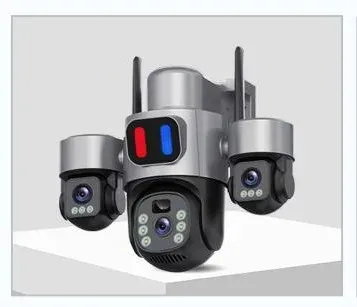
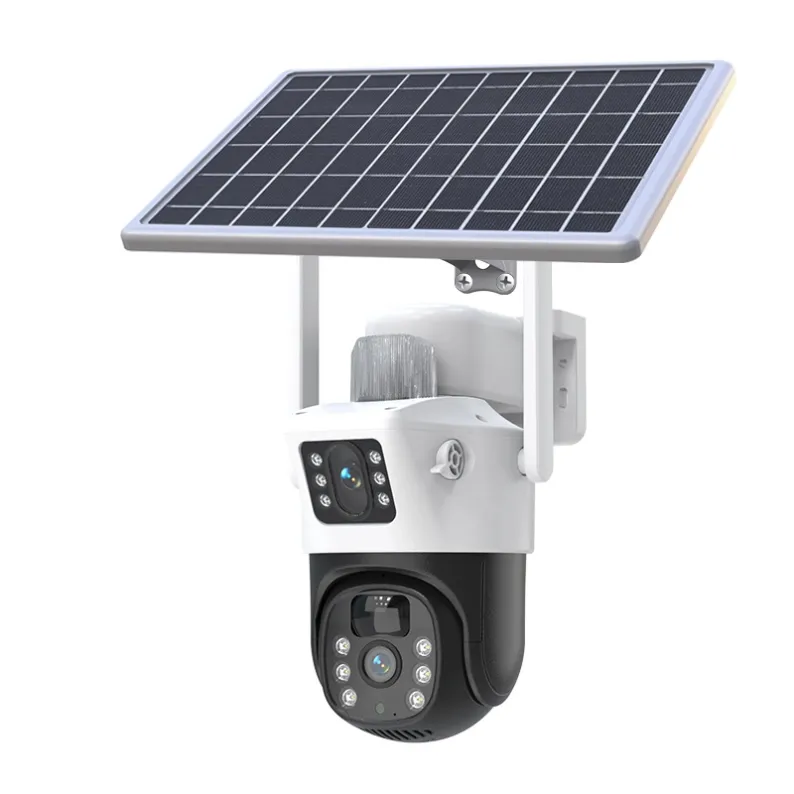
A pump station with an approach track is a pan-tilt job. A PTZ body lets you sweep the track and then settle on the door, and a dual-lens or multi-lens unit gives you a wide view and a closer view at the same time. In our solar range the dual-lens PTZ models pair two 4mm lenses with 355 degree horizontal and 90 degree vertical movement on a 10800mAh battery and a 7.5W panel, with infrared and full-colour night vision and intelligent human detection.
A distant trough or a long fence line at a water point is a zoom job. If the camera has to sit at the pump house and watch a trough forty metres away, optical zoom does more for you than resolution does. Our 20x optical zoom models use a dual-lens, dual-view arrangement at 6MP with colour plus infrared night vision and PIR human detection, which suits a site where the camera and the asset cannot share a mounting point.
An equipment yard beside the pump, or a tank compound where you want the site lit as well as watched, argues for a floodlight or street lamp style unit. Those models pair the camera with lighting on the same power budget, so a night approach is both illuminated and visible as a deterrent. Our 20W floodlight model is 3MP with colour plus infrared night vision and PIR human detection.
A very large compound with several directions to cover, where you want one unit to see all of them, points to a multi-lens model. A four-lens unit at 20MP gives four simultaneous views and colour plus infrared night vision, which reduces the number of separate cameras you have to power and connect at one site.
Signal at a water point is usually the hardest constraint
Water infrastructure is often placed where the terrain dictated rather than where coverage is good: the low corner of a field, behind a rise, or at the far end of the property. Test the signal standing at the mount, with the same handset the site owner will use, and test both what you intend to rely on and what is available as a fallback.
Where cellular works at the pump, order the regional 4G version that matches the destination market. Bands differ between regions and a unit built for one market may not register on another market's network, which on a water site is not a repairable mistake. Where no signal reaches the pump, local-card recording is the honest configuration: you still get the footage, and you retrieve it when someone next visits the site, which for a water point is often already on a schedule.
Mounting at a water point: five practical rules
Height beats angle. Mounting at three metres or so puts the camera above easy reach and above the eye line of livestock, and gives a view down the approach rather than across it. A camera at chest height beside a tank gets pushed, sprayed or blocked.
Keep the lens clear of the structure. Do not mount flush against a tank wall or under a roof overhang that fills the frame. Leave enough standoff that the field of view starts a few metres out.
Protect the cable even when the camera is wireless. A solar camera still has a panel lead, and that lead is the easiest thing on the site to cut. Route it where it cannot be reached from the ground, and treat a cut lead as an event you want recorded, not just a fault.
Do not mount on the pump itself. Vibration from a running pump blurs night footage and works fixings loose. Use a separate post or the tank stand.
Aim at the approach, not the asset. The asset is what you are protecting, but the approach is what tells you who came. If you can only have one view, take the approach.
How a camera fits an existing pump alarm
Most working pump installations already have some automation: a float switch, a dry-run protector, a pressure switch, or a timer. Those devices tell you that something is wrong. A camera tells you what happened, which is a different and complementary answer, and the two together are far more useful than either alone.
The practical arrangement is that the controller raises the alarm and the camera supplies the evidence. A dry-run trip at three in the morning becomes a question of whether the borehole dropped, whether a valve was closed, or whether someone interfered with the head works. The camera answers that question without a site visit. It also gives you a record for an insurance claim or a police report, which an alarm log alone does not.
What the camera should not do is replace the alarm. Relying on a person watching a live feed is not a control system, and a camera that is only reviewed after a loss has already happened is a record rather than a protection.
Seasonal and unattended sites
A water point on a property that is empty for part of the year needs different priorities from one that is visited daily. The camera has to survive without intervention, the recording mode has to be low-draw, and the retrieval plan has to assume nobody is coming for weeks. That points to local-card recording with the largest card the model supports, a conservative recording mode, and a mounting position chosen so that snow sheds and the panel stays clear.
It also changes what counts as a good result. On an unattended site the win is not catching someone in the act; it is finding out within days rather than at the start of the season. If the site has any link at all, even an intermittent one, the alerts are worth more than the live view.
Frequently asked questions
Can a camera tell me when my tank is empty? No. A camera shows the site; it does not measure level. Use a level sensor or float switch for the alarm, and a camera to show you why the alarm fired.
Will one camera cover a pump house and a trough? Usually only if they are within the same field of view from one mounting point. A pan-tilt model can sweep between them, but it records what it is pointing at, so if both need simultaneous coverage, use a dual-lens or multi-lens model, or two cameras.
Do I need a floodlight model at a pump station? Not necessarily, but lighting changes the deterrent value at night and makes identification easier. If the site is genuinely dark and the pump is valuable, a model that pairs the camera with lighting on one power budget is usually the better buy.
How do I stop the camera being taken? You cannot guarantee it. You can make it harder: mount above reach, keep the panel lead out of reach, record locally so footage survives the camera being removed, and treat a tamper as an alert event rather than a silent loss.
What if there is no signal at the pump at all? Record to a local card. You lose remote live view and push alerts, but the footage is there and you retrieve it on the next visit. Confirm the card size against how often someone actually visits.
Can the camera survive spray from a pressure washer or a leaking pipe? Check the IP rating on the datasheet and mount where the camera is not in the direct path of spray. A higher IP rating buys time against weather, not against a jet pointed at the lens.
What to send a supplier before you specify
A supplier can only size a water-point installation against the site. Photographs of the approach, the tank and the pump house, plus a signal reading taken at the mount, are worth more than a description.
The site layout: where the pump, tank and trough are, which direction anything would arrive from, and how far the camera would be from each.
Power and sun: whether there is any power at the site, and how much direct sun the candidate mount gets in the worst month.
Signal: what the handset shows at the mount for the network the site will use, and the destination country so the correct 4G band version can be quoted.
Recording need: events only, or continuous coverage. This single answer changes the panel and battery specification more than anything else.
Climate: the coldest winter temperature the site operates in, typical snowfall, and whether the mount is exposed to wind-driven snow.
Commercial context: whether you are the farm, a dealer quoting a project, or a brand planning a line, together with quantity and destination market.
Ordering from the factory
KeenCamPro manufactures in Huizhou, Guangdong and supplies solar and 4G camera ranges direct to farms, dealers and brand owners. The solar range covers compact single-lens PTZ bodies through dual-lens and multi-lens units to four and five-lens AOV cameras with optical zoom up to 36x, plus solar street lamp and floodlight models, trail cameras and plug-in ranges. Regional 4G versions are available for the main markets, and OEM and ODM projects are supported with custom branding and packaging.
For a water-point specification, send the site details above through the contact form, and the sales team will confirm the camera category, the regional 4G version and the power configuration for each spot.
Browse the solar camera, AOV camera and PTZ and zoom categories on the website, or contact the export team at sales@keencampro.com or diana@keencampro.com, or on WhatsApp at plus 86 189 4857 9719.